


By David Kent, President, David Kent Consulting
How Higher Education Institutions Can Preserve Control While the ERP and SIS Market Continues to Re-Sort
Blog 5 of 5 | 2,947 words | Approximately 14 minutes
——————————————————
By David Kent, President and Founder, David Kent Consulting, Inc.
This is the fifth and final article in our five-part series, ERP Strategy in a Re-Sorting Market.
In the first article, “Your Vendor’s Roadmap Is Not Your ERP Strategy,” we discussed why colleges and universities must define their own institutional direction rather than allowing incumbent-vendor pressure, product roadmaps, or artificial deadlines to determine their future.
In the second article, “The Higher Education ERP Market Is No Longer a One-Way Road,” we examined the growing number of credible ERP and SIS paths available to institutions.
In the third article, “Do Not Wait for the Perfect ERP: Modernize What You Control Today,” we focused on practical modernization, including the ability to complete a focused cloud modernization and migration in approximately 14 weeks while broader institutional readiness work continues in parallel.
In the fourth article, “Not Every ERP Decision Belongs on the Same Timeline,” we examined how institutions can distinguish between decisions that should be made now, decisions that should be investigated now, and decisions that should deliberately wait for stronger evidence.
The final principle ties the entire series together:
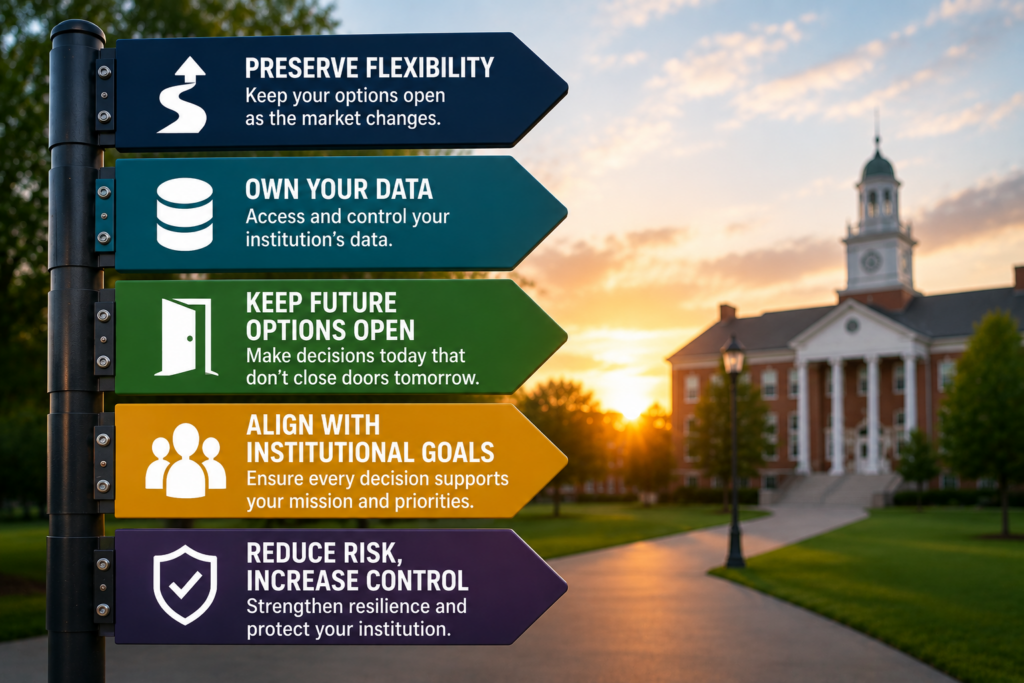
Institutions should actively preserve optionality.
Optionality is sometimes mistaken for indecision.
It is not.
Indecision means avoiding choices that need to be made.
Optionality means making deliberate choices that preserve the institution’s ability to respond when products, vendors, technologies, costs, and institutional priorities change.
In a market that is still re-sorting, that flexibility is not a sign of weakness.
It is a strategic asset.
What Optionality Really Means in Higher Education
Optionality does not mean refusing to commit to anything.
Institutions still need to act.
They must address security risks, aging infrastructure, operational fragility, staffing dependencies, contract exposure, data problems, and process inefficiency.
They must make decisions about investments, governance, architecture, and operating models.
The question is whether those decisions unnecessarily eliminate future choices.
An institution preserves optionality when it can:
- Change vendors without rebuilding the entire enterprise environment
- Move individual administrative domains independently when appropriate
- Access and extract its own data without unreasonable obstacles
- Replace integrations without recreating every institutional business rule
- Shift hosting or cloud strategy without forcing an application decision
- Renegotiate services without losing operational continuity
- Adopt new capabilities without surrendering control of the broader architecture
- Exit a product or service relationship under known and manageable conditions
Optionality is therefore not the absence of decisions.
It is the result of better decisions.
Why Optionality Has Measurable Value
Strategic flexibility can sound abstract until an institution loses it.
The value becomes obvious when:
- A vendor raises prices unexpectedly
- A product roadmap changes
- A promised capability is delayed
- A merger or acquisition alters support priorities
- A SaaS contract becomes difficult to exit
- A critical integration can only be maintained by one vendor
- Institutional data is difficult to extract
- A new product becomes more attractive than the one previously selected
- Leadership priorities change
- Budget conditions tighten
- A security or resilience issue requires faster action than the vendor roadmap allows
An institution with few alternatives has less negotiating leverage.
It may be forced to accept pricing, timing, functionality, and contractual terms that it would otherwise challenge.
An institution with credible alternatives can negotiate from a position of strength.
That does not mean constantly threatening to leave.
It means the institution has retained enough control that leaving, changing direction, or separating services remains possible.
Optionality can reduce:
- Switching costs
- Transition risk
- Vendor dependence
- Contractual exposure
- Time required to respond to market changes
- Cost of adopting new capabilities
- Risk of being trapped by a product that no longer fits
It can also increase:
- Negotiating leverage
- Architectural resilience
- Implementation flexibility
- Ability to innovate
- Responsiveness to institutional priorities
- Confidence in long-term planning
Those are tangible benefits.
Architecture Determines How Much ERP Choice You Really Have
Institutions often discuss optionality as though it were primarily a procurement issue.
It is also an architectural issue.
The design of the enterprise environment determines how easily individual components can change.
A tightly coupled environment makes every change larger.
A loosely coupled, well-governed environment allows institutions to replace or improve components without destabilizing everything around them.
Key architectural characteristics that preserve optionality include:
- Clear systems of record
- Well-documented APIs
- Standard integration patterns
- Independent identity and access management
- Portable data models
- Centralized monitoring
- Documented business rules
- Minimal dependence on proprietary extensions
- Repeatable infrastructure automation
- Separation between application, integration, data, and presentation layers
None of these guarantees that change will be easy.
Enterprise transitions are rarely easy.
But they can prevent change from becoming unnecessarily difficult.
ERP Integration Independence Is Strategic Independence
Every modern institution operates in a multi-application environment.
Even institutions that adopt a broad integrated suite will continue to use specialized applications for learning, research, advancement, advising, payments, identity, reporting, analytics, compliance, and many other functions.
That means integration will remain central.
If the integration architecture is owned entirely by one application vendor, the institution may discover that its flexibility is much more limited than expected.
Institutions should ask:
- Who controls the integration platform?
- Can integrations connect products from competing vendors?
- Are APIs complete, stable, and documented?
- Can the institution monitor and troubleshoot integrations directly?
- Are data transformations visible and portable?
- Can another partner maintain the integrations?
- Are institutional business rules embedded inside proprietary tools?
- What happens to integrations if the primary application changes?
A strong integration strategy should allow the institution to connect, replace, and add applications without surrendering control of the enterprise ecosystem.
That is why integration is not merely a technical service.
It is a strategic capability.
Data Portability Is Nonnegotiable in Higher Education ERP Strategy
Institutional data is not a byproduct of the software.
It is an institutional asset.
EDUCAUSE’s 2025 Top 10 identified the data-empowered institution as higher education’s number one priority, reinforcing that data management, integration, and governance must remain under institutional control regardless of which platform hosts the applications.
Any ERP, SIS, SaaS, cloud, or managed-services strategy should preserve practical access to that asset.
Institutions should understand:
- What data can be accessed directly
- How frequently data can be extracted
- Whether complete historical data is available
- What formats are supported
- Whether metadata and relationships are preserved
- Whether additional fees apply
- How long extraction would take
- What assistance is provided during transition or termination
- Whether data remains available after the contract ends
- Whether reporting access depends on continued subscription to other products
Contract language promising that the institution “owns its data” is not enough.
Ownership without usable access has limited value.
The institution must be able to retrieve, understand, and use the data without unreasonable cost, delay, or vendor intervention.
Data portability should be tested, not merely promised.
Institutions should periodically validate that exports are complete, usable, documented, and capable of supporting recovery or transition.
Contract Terms Can Preserve or Destroy Optionality
Technology strategy and contract strategy cannot be separated.
A technically flexible architecture can still become locked in through commercial terms.
Institutions should evaluate contracts for:
- Renewal structure
- Price-escalation limits
- Minimum commitments
- Bundling requirements
- Module dependencies
- Termination rights
- Data-extraction provisions
- Transition assistance
- Post-termination access
- Service-level obligations
- Change-of-control protections
- Audit rights
- Security and incident obligations
- Rights to use alternative service providers
- Ownership of configurations, integrations, and developed materials
The strongest time to negotiate exit provisions is before entering the relationship.
Once the institution is dependent on the service, its leverage is reduced.
Institutions should also avoid assuming that longer contracts always create better economics.
A long-term commitment may reduce annual pricing while increasing strategic exposure.
The relevant question is not only:
What will this cost if we stay?
It is also:
What will this cost if we need to change direction?
Modularity Creates More Than Technical Flexibility
A modular strategy allows an institution to make different decisions for different domains.
Finance, human resources, payroll, student, research, advancement, budgeting, analytics, identity, and integration do not necessarily need to move together.
That does not mean every institution should create a collection of disconnected products.
It means institutions should challenge the assumption that every enterprise decision must be bundled into one transformation.
Modularity can allow an institution to:
- Address the most urgent need first
- Reduce the scale of each implementation
- Select stronger capabilities for specific functions
- Spread organizational change over time
- Preserve a viable system while another domain changes
- Avoid replacing components that continue to work well
- Adapt as products mature at different rates
But modularity requires discipline.
Without strong governance, it can create duplication, inconsistent data, fragmented user experiences, and unmanageable vendor sprawl.
The goal is not maximum fragmentation.
The goal is controlled flexibility.
Avoid Lock-In Disguised as Simplicity
Vendors often promote the value of a unified suite.
That value can be real.
A shared data model, common security framework, consistent user experience, and coordinated product roadmap may reduce complexity.
But simplicity can become dependence when:
- Critical capabilities are available only through proprietary tools
- Data access requires additional subscriptions
- Integrations are limited to the vendor’s preferred ecosystem
- Pricing is bundled across unrelated modules
- Replacing one function requires renegotiating the entire suite
- Institutional processes become inseparable from vendor-specific configuration
- Exit requires rebuilding identity, integration, reporting, and workflow simultaneously
Institutions should evaluate both sides of suite economics.
The suite may reduce some forms of complexity while increasing the cost of changing direction.
A sound strategy asks:
- Which dependencies are acceptable?
- Which dependencies create unacceptable risk?
- What would be difficult to unwind later?
- Are the efficiency benefits worth the reduction in flexibility?
- Can the institution maintain independent control over identity, integration, and data?
The answer may still support an integrated suite.
But it should be an informed decision.
Public Cloud Can Preserve Application Choice
Public-cloud modernization can play an important role in preserving optionality because infrastructure strategy and application strategy do not have to be the same decision.
An institution can modernize its existing ERP environment, improve resilience, automate operations, strengthen security, and reduce infrastructure risk without committing to a future SIS or ERP product.
A focused modernization and migration can often be completed in approximately 14 weeks.
That allows the institution to make meaningful progress now while continuing to evaluate the broader market.
The value is not merely that the current system operates in a different location.
The value is that the institution can create a more automated, documented, resilient, and portable operating foundation.
Infrastructure-as-Code, standardized configurations, improved observability, right-sized capacity, tested recovery, and clearer operational ownership can all reduce dependence on legacy assumptions.
Public cloud does not automatically create optionality.
A poorly designed environment can create new forms of lock-in.
But when architecture, automation, documentation, and exit planning are handled properly, cloud modernization can increase the institution’s ability to respond.
David Kent Consulting provides cloud solutions and infrastructure modernization services specifically designed for institutions seeking to preserve application choice while improving their operating environment.
AI Makes ERP Optionality More Important, Not Less
Artificial intelligence is likely to change how users interact with enterprise systems.
Over time, students, faculty, staff, and administrators may rely less on navigating individual application screens and more on intelligent services that work across multiple systems.
An AI-enabled service may need access to:
- Student information
- Financial data
- HR information
- Policies
- Documents
- Advising data
- Learning systems
- Identity services
- Institutional knowledge
- Workflow and transaction services
That future favors institutions with accessible data, strong APIs, well-governed identity, documented business rules, and clear security boundaries.
It disadvantages institutions whose data and processes are trapped inside closed systems.
AI also increases uncertainty.
Capabilities that appear central today may become less important as new interaction models emerge.
Institutions should therefore be cautious about making irreversible commitments based on today’s interface assumptions.
The strategic question is not only whether a platform has an AI feature.
It is whether the institution can use its data, connect external services, govern access, and adopt new capabilities as the market changes.
Optionality is what allows the institution to benefit from innovation without surrendering control to whichever vendor introduces the first compelling feature.
Governance Preserves Optionality Over Time
Optionality is not created once and then preserved automatically.
It can be lost gradually through a series of small decisions.
A department purchases a specialized application without integration review.
A contract renews automatically with stronger bundling requirements.
A critical business rule is embedded in custom code.
A vendor-specific reporting tool becomes the only practical way to access data.
A temporary integration becomes permanent.
A cloud environment grows without standards or documentation.
Each decision may seem manageable in isolation.
Together, they can eliminate flexibility.
Institutions need governance that reviews decisions through an enterprise lens.
That governance should ask:
- Does this decision create a new dependency?
- Is that dependency justified?
- Is the data accessible and portable?
- Can the capability be integrated and monitored?
- Is the contract modular?
- Who owns the configuration and documentation?
- What is the exit path?
- Does this investment remain valuable under multiple future scenarios?
- Are we preserving or reducing institutional leverage?
Governance should not become bureaucracy for its own sake.
Its purpose is to prevent local convenience from creating enterprise constraint.
Measure ERP Optionality With an Institutional Scorecard
Institutions should evaluate optionality explicitly rather than relying on general impressions.
A practical scorecard can include the following questions.
Data
- Can the institution access complete operational and historical data?
- Are exports usable, documented, and regularly tested?
- Can data be moved without unreasonable cost or delay?
- Are authoritative sources and ownership clearly defined?
Integration
- Are integrations documented?
- Are APIs open, complete, and well supported?
- Can multiple partners build and maintain integrations?
- Are institutional rules portable?
- Can integrations be monitored independently?
Architecture
- Can major components be changed independently?
- Is identity controlled at the institutional level?
- Is infrastructure automated and documented?
- Are proprietary dependencies understood?
- Can the environment support multiple vendors and clouds where needed?
Contracts
- Are price increases bounded?
- Can modules be changed or removed?
- Are exit and transition obligations defined?
- Does the institution retain access to data after termination?
- Can alternative service providers be used?
Operations
- Is institutional knowledge documented?
- Are critical functions dependent on one person or vendor?
- Can recovery be tested independently?
- Are costs transparent?
- Are governance and decision rights clear?
Market Readiness
- Are decisions based on delivered capability rather than roadmap promises?
- Are alternatives periodically reviewed?
- Are decision gates defined?
- Does the institution know what conditions would justify changing direction?
A low score does not automatically mean the institution should replace a system.
It means leadership should understand where dependence exists and decide whether that dependence is acceptable.
Optionality Requires the Courage to Say No
Preserving choice sometimes requires declining an attractive short-term offer.
A vendor may offer better pricing in exchange for a longer commitment.
A bundled package may appear less expensive than separate products.
A proprietary integration tool may be faster to deploy.
A customization may solve an immediate problem.
A roadmap promise may seem sufficient to justify action.
The institution must evaluate not only the immediate benefit but also the long-term constraint.
Sometimes the right answer will still be yes.
But the decision should be made with full awareness of what is being surrendered.
Optionality has a cost.
So does lock-in.
The institution should compare both.
Optionality Is Not an Excuse to Delay Necessary Action
There is an important caution.
Leaders can misuse the language of flexibility to avoid difficult decisions.
That is not strategy.
An institution should not preserve an outdated platform indefinitely merely because replacement would reduce some options.
It should not tolerate security risk, operational failure, unsustainable cost, or poor service in the name of optionality.
The purpose of preserving choice is to support better action, not to prevent action.
A disciplined institution will know:
- Which risks require immediate response
- Which investments are valuable under multiple scenarios
- Which decisions can be reversed
- Which decisions are truly irreversible
- What evidence is needed before committing
- When continued waiting becomes more dangerous than moving
Optionality and decisiveness are not opposites.
The strongest strategy combines both.
The Institution Should Control the Sequence
Across this series, one idea has remained constant.
The institution should control the sequence of decisions.
Vendor pressure should not determine strategy.
Market uncertainty should not produce paralysis.
Modernization should not wait for a perfect future product.
Every decision should not be forced onto the same timeline.
And no institution should surrender more flexibility than necessary simply because one vendor presents its roadmap as inevitable.
The institutions best positioned for the future will not necessarily be those that move first.
They will be those that:
- Define institutional priorities clearly
- Modernize the areas they control
- Separate infrastructure decisions from application decisions where appropriate
- Evaluate products based on delivered evidence
- Sequence decisions deliberately
- Preserve access to data
- Maintain integration independence
- Negotiate contracts with exit in mind
- Build governance that protects enterprise interests
- Retain the ability to respond as the market changes
The Final Standard
No institution can predict with certainty which products, vendors, delivery models, or AI capabilities will lead the market five or ten years from now.
That is not the standard by which ERP and SIS strategy should be judged.
A successful strategy enables the institution to make meaningful progress today without unnecessarily limiting tomorrow.
It reduces known risks.
It improves current operations.
It creates clearer decision points.
It strengthens negotiating leverage.
It preserves the ability to change direction when the evidence justifies it.
The institutions that succeed in this re-sorting market will not necessarily be those that correctly predict every market move.
They will be those that preserve enough control to respond intelligently as those moves unfold.
Optionality is not indecision.
It is how institutions remain in control of their own future.
Key Takeaways
- Optionality is not indecision or delay. It is a deliberate strategy for preserving the ability to change direction at a reasonable cost as the higher education ERP and SIS market continues to evolve. Institutions that protect their choices today will be in the strongest position regardless of which platform they ultimately select.
- Architecture, integration independence, and data portability are the three foundations of institutional optionality. Institutions with open APIs, documented integrations, and portable data can evaluate and adopt new platforms on their own terms. Those locked into proprietary tools, vendor-controlled integrations, and inaccessible data have already surrendered much of their strategic flexibility.
- Contract terms can preserve or destroy optionality. Institutions should negotiate for data extraction rights, API commitments, reasonable exit provisions, and protection against pricing changes that are not tied to delivered value. Every contract should be evaluated for what it costs to leave, not just what it costs to stay.
- AI will increasingly deliver capabilities through services that operate across multiple systems rather than within a single vendor suite, making data access, integration flexibility, and architectural independence more important than ever. Institutions that have locked their data and integrations inside a single platform will have fewer options to benefit from these changes.
- ERP optionality should be measured with a scorecard that evaluates data control, integration independence, architectural flexibility, contractual freedom, operational resilience, and market readiness. A low score does not automatically mean replacement. It means leadership should understand where dependence exists and decide whether that dependence is acceptable.
About David Kent
David Kent is the founder and president of David Kent Consulting, Inc., a higher education technology consulting firm that has served more than 200 colleges and universities. For more than 25 years, he has helped institutions navigate ERP and SIS strategy, cloud modernization, integration, and enterprise technology decisions. David is a strong advocate for institution-led strategy, practical modernization, and maintaining independence from vendor-driven roadmaps and artificial timelines.
About David Kent Consulting
David Kent Consulting helps higher education institutions take control of their enterprise technology futures. For over 25 years and across more than 200 institutional engagements, our team has provided independent ERP and SIS strategy, cloud modernization, integration architecture, and vendor evaluation services. We believe institutions should define their own technology direction rather than inherit it from vendors, and we bring the practitioner expertise to make that independence practical.
Frequently Asked Questions
What is ERP vendor lock-in and how can universities avoid it?
ERP vendor lock-in occurs when an institution becomes so dependent on a single vendor’s proprietary tools, data formats, integration methods, or contractual terms that switching to an alternative becomes prohibitively expensive or operationally disruptive. Universities can reduce vendor lock-in by insisting on open APIs, maintaining data portability, documenting integrations independently of vendor-specific tools, negotiating reasonable exit provisions, and periodically evaluating whether their architecture preserves or limits future choices.
What is data portability in higher education ERP?
Data portability means the institution can extract, move, and use its own data without unreasonable technical barriers or vendor restrictions. In practice, this means data should be available in standard formats through documented APIs, accessible for reporting and analytics without vendor-specific tools, and exportable in full at contract termination. Institutions should treat data portability as a nonnegotiable requirement in any ERP strategy, not an afterthought during contract negotiations.
How does AI change ERP strategy for higher education?
AI is increasingly delivering capabilities through services that operate across multiple systems rather than within a single vendor suite. This means institutions with open data access, flexible integrations, and architectural independence will have more options to benefit from AI than those locked into a single platform. The most valuable AI applications may eventually come from providers that are not ERP vendors. Institutions should ensure their architecture can support AI services regardless of where their enterprise applications reside.
What should universities include in ERP contract negotiations to preserve flexibility?
Key provisions include data extraction rights in standard formats, documented API commitments, reasonable termination and transition assistance provisions, protection against price increases not tied to delivered value, clarity about what happens to institutional data at contract end, and limits on vendor-imposed upgrade or migration timelines. Every contract should be evaluated for what it costs to leave, not just what it costs to stay.
What is an ERP optionality scorecard?
An ERP optionality scorecard is a framework for measuring how much strategic flexibility an institution actually has across six dimensions: data (can it be extracted and moved?), integration (can interfaces operate independently of the vendor?), architecture (is the environment modular?), contracts (do terms permit change?), operations (are critical functions documented and not dependent on a single vendor?), and market readiness (are decisions based on evidence rather than vendor pressure?). A low score does not automatically mean replacing a system, but it means leadership should understand where dependence exists.
